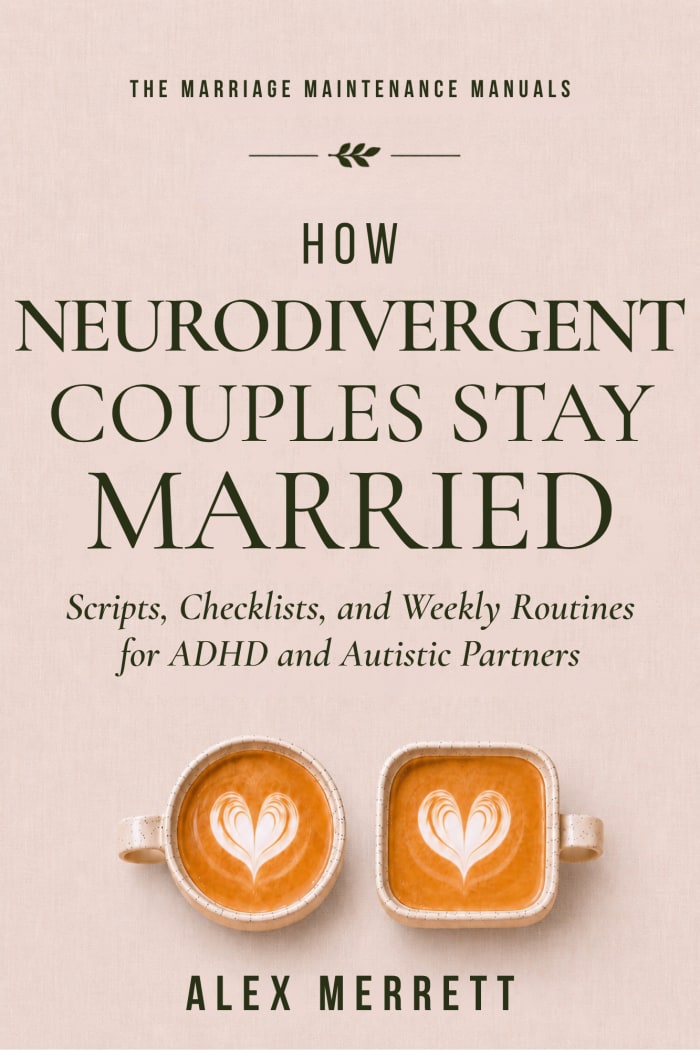
What's Inside
Ten chapters.
Organised by what goes wrong,
not by diagnosis.
Each chapter names a specific failure mode, explains why it happens in neurodivergent relationships, and installs a protocol to resolve it. Open to the chapter that describes your biggest friction point.
Chapter 1
The Entryway Collision
Decompression needs collide with connection needs at the door. The 20-Minute Arrival Blueprint resolves this without negotiation.
20-Minute Arrival Blueprint
Verbal Shortcut System
Emergency Stop Rule
Chapter 2
The Sensory Spiral
Mid-conversation sensory overload causes processing breakdown. The Sensory Audit Protocol identifies triggers in advance and installs no-explanation-required scripts.
Sensory Audit Protocol
Overload Scripts
Chapter 3
The Executive Function Cascade
EF dysfunction creates cascading tasks in shared spaces. Space-specific decision trees handle the kitchen, the laundry, and the bathroom without shame or negotiation.
EF Decision Trees
Capacity Scripts
Chapter 4
The Processing Mismatch
Internal and external processors reach mutual overwhelm. Timing matrices and processing request scripts bridge the gap without one partner shutting down.
Processing Bridge Blueprint
Timing Matrix
Chapter 5
The Rejection Sensitivity Spike
RSD transforms neutral interactions into perceived attacks. The RSD Physical Diagnostic identifies active episodes. The 10-minute circuit breaker interrupts the spiral.
RSD Physical Diagnostic
Circuit Breaker Protocol
Chapter 6
The Shutdown vs Stonewalling
Autistic shutdown looks like deliberate withdrawal. The Shutdown Diagnostic Blueprint distinguishes involuntary shutdown from stonewalling so you can respond correctly.
Shutdown Diagnostic Blueprint
If/Then Protocol
Chapter 7
The Invisible Labor Asymmetry
Mental load redistribution fails when based on fairness instead of capacity. The Low-Capacity Handover Blueprint redistributes cognitive tasks based on what each partner can actually carry today.
Low-Capacity Handover Blueprint
Mental Load Inventory
Chapter 8
The Decision Fatigue Spiral
Small-choice accumulation causes choice paralysis. Automation protocols and default-setting systems eliminate recurring decisions before they drain capacity.
Default-Setting Protocol
Decision Automation Matrix
Chapter 9
The Morning After
Post-dysregulation resets that re-trigger the original incident. The 24-Hour Household Reboot Protocol restores systems without requiring detailed processing when capacity is lowest.
24-Hour Reboot Protocol
Universal Emergency Stop
Chapter 10
The Avoided Conversation
Necessary difficult conversations never happen because the window never opens. The Difficult Conversation Blueprint schedules high-stakes discussions when both partners are regulated.
Conversation Blueprint
Triage System